

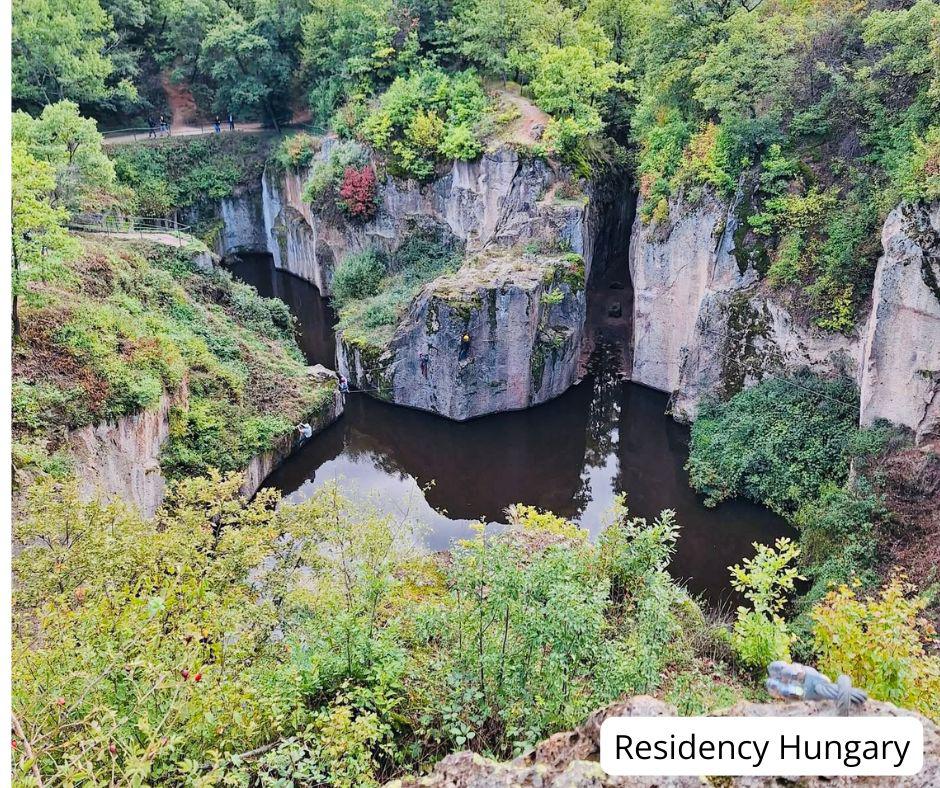
Above the ancient city of Sárospatak, also known as the “Athens of the Bodrog,” lies the famous Megyer-hegyi sea cave. From the 15th century until 1907, both nature and human activity shaped this expansive cave. Perched on the cliff face, the view surrounding the cave is truly breathtaking. The sea cave, which was artificially created, is situated precisely at the summit of a 324-meter-high mountain.
The area where the Sea Eye once carved into the tuff was originally a millstone quarry. This simultaneously terrifying and stunningly beautiful rock formation, accessible via hiking trails, has an intriguing history. Local miners discovered that the hard rock of the mountain, known as rhyolite tuff, was suitable for producing millstones. As a result, mining operations continued in this area until 1907, leading to the formation of a large pit. Rainwater collected in this pit, creating a lake with a maximum depth of 6.5 meters. The rock walls surrounding the lake rise 70 meters above the water's surface. During the mining period, miners also carved small niches into the rock walls, providing them with shelter for the night.
Today, remnants of half-finished millstones and other stone-carving by-products can still be found in the former quarry area, which is now managed by Aggtelek National Park. In 1997, the lake was designated as a nature reserve, and in recent years, significant developments have been undertaken to enhance its appeal as a tourist destination.
A lookout tower is being constructed at the highest point of the area, and the country’s longest via ferrata, along with suspension bridges and a bike path, has also been completed. Additionally, a showroom is planned where visitors can learn about the history of millstone production from the 15th to the 17th centuries.
Currently, you can take in views from above, behind protective railings, overlooking the edge of the mine and the water-filled rock cauldron. To observe the lake's current inhabitants, such as frogs and water snails, it’s worth venturing through the narrow path that leads to the edge of the lake. This is the interior of the former mine.
The area offers a variety of attractions, and a 17-station educational trail has been created that starts from the city center of Sárospatak. This trail includes highlights such as the charming Swabian village of Hercegkut, Megyer-hegy Lake, Király-hegy, and the Nagy-Bot-kő geyser cone. It also passes by the historic Gombos-hegy and Kőporos cellar rows and introduces visitors to the natural and artificial flora typical of the region. The Malomkő educational trail culminates in the castle garden of Rákóczi Castle in Sárospatak. After a four to five-hour tour, you can relax near the old Japanese acacia, which is the emblematic tree of the garden.