

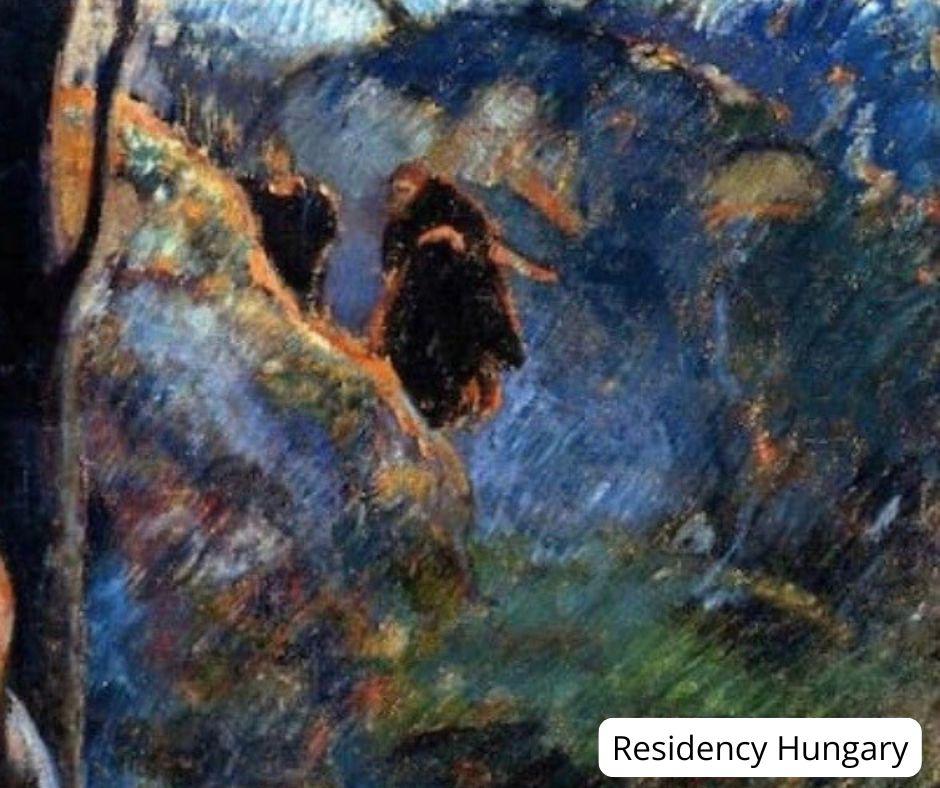
Born in Paris, Eugène Henri Paul Gauguin is rightly regarded as one of the most influential figures in 19th-century art. Alongside Cézanne and Van Gogh, he is one of the leading figures of Post-Impressionism. Bold in his use of color and constantly experimenting with new forms of expression, Gauguin developed a distinctive style that had a profound influence on the development of modern art.
Gauguin, a father of five, led an extraordinarily adventurous life. He lived in Peru, Panama and Tahiti, as well as on the Marquesas and Martinique. Before devoting himself fully to art, he worked as a sailor and a stockbroker. He only took up painting seriously later in life, and his first landscape was exhibited when he was 28. His friendship with Vincent van Gogh inspired a number of works and contributed to important changes in both artists’ approaches, although their relationship eventually came to an end. Gauguin’s years living among the indigenous people of Tahiti became a defining experience in his life and provided the dominant subject matter of his later work.
Opening on October 30, the exhibition Bonjour Monsieur Gauguin: The Circles of the Post-Impressionists and Symbolists will bring together 150 masterpieces, including 80 works by Gauguin, the Museum of Fine Arts announced on Thursday.
Almost 40 lending institutions have contributed to the exhibition, among them The Metropolitan Museum of Art and the Museum of Modern Art (MoMA) in New York, the National Gallery of Art in Washington, the Musée d’Orsay in Paris, the Van Gogh Museum in Amsterdam, Tate in London, and the Museo Nacional Thyssen-Bornemisza in Madrid.
On view until the end of February next year, the exhibition traces Gauguin’s artistic journey and explores the intellectual and artistic developments that helped pave the way for modernism in the art of the late 19th century. In addition to works by the Post-Impressionist master, visitors will be able to discover works by his predecessors and contemporaries, including Gustave Courbet, Camille Pissarro, Claude Monet, Paul Cézanne, Vincent van Gogh, Émile Bernard, and Paul Sérusier.
The exhibition continues the Museum of Fine Arts’ internationally acclaimed series of Impressionist and Post-Impressionist exhibitions, which has been running for more than two decades and has featured major exhibitions devoted to artists such as Monet, Van Gogh, Cézanne, and Renoir.
These exhibitions have presented 19th-century art from a modern art-historical perspective, combining a strong scholarly foundation with an approach accessible to a broad audience. The Gauguin exhibition builds on this more than two-decade-long tradition of curatorial expertise and high-profile exhibition-making.